
Navigating Your Options: Different Types of Bookkeeping
Bookkeeping is the backbone of reliable financial management. It involves recording and organizing daily financial transactions—including sales, purchases, and expenses—to provide a transparent picture of your company's fiscal health.
However, choosing the right accounting system can be challenging. Below, I break down the three primary bookkeeping methods to help you determine the best fit for your operations.
1. Single-Entry Bookkeeping
Single-entry bookkeeping is the most straightforward method available. It involves recording transactions in a single column, where each entry is logged once as either revenue or an expense (much like keeping a personal checkbook ledger).
The Pros: Highly cost-effective and suitable for brand-new solopreneurs or micro-businesses with a low volume of simple transactions. It requires zero specialized accounting software.
The Cons: It fails to provide a comprehensive picture of your financial health. It does not track assets or liabilities, nor does it generate the detailed financial reports needed for business loans or advanced auditing.
2. Double-Entry Bookkeeping
Double-entry bookkeeping is the global standard for established businesses. It operates on a fundamental accounting equation: Assets = Liabilities + Equity. Every transaction is recorded twice—once as a debit and once as a credit—ensuring your books always balance perfectly.
The Pros: Provides an error-checked, complete map of your financial health and generates advanced financial statements (like Balance Sheets and P&L statements).
The Cons: Requires specialized accounting knowledge and a strict attention to detail to execute correctly without creating discrepancies.
3. Computerized Bookkeeping
Computerized bookkeeping utilizes modern cloud accounting software to automate and organize your financial records. It seamlessly applies double-entry accounting principles behind the scenes while drastically reducing manual entry.
The Pros: Drastically reduces human error, offers real-time access to financial dashboards, and automates tedious tasks like invoicing, receipt scanning, and recurring expense tracking.
The Cons: Requires a monthly software subscription and basic digital onboarding training to configure the chart of accounts properly.
How to Choose the Best Method for Your Business
Selecting your framework shouldn't involve guesswork. The ideal system depends on your specific business structure:
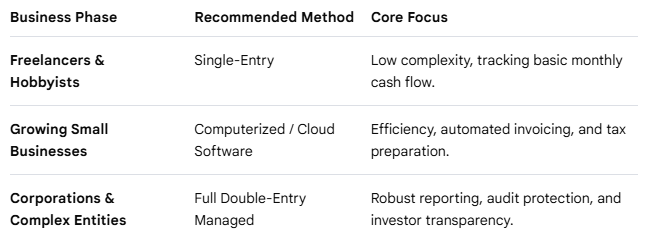
Let the Professionals Handle the Complexity
Choosing the wrong bookkeeping method can lead to unorganized records, messy tax filing, and missed write-offs. If your business finances are becoming too complex to handle on your own, outsourcing to an expert ensures absolute clarity.
Connect with Poe Bookkeeping Today to schedule a consultation. Our expert team will help you implement the perfect financial system tailored to your unique business goals.